

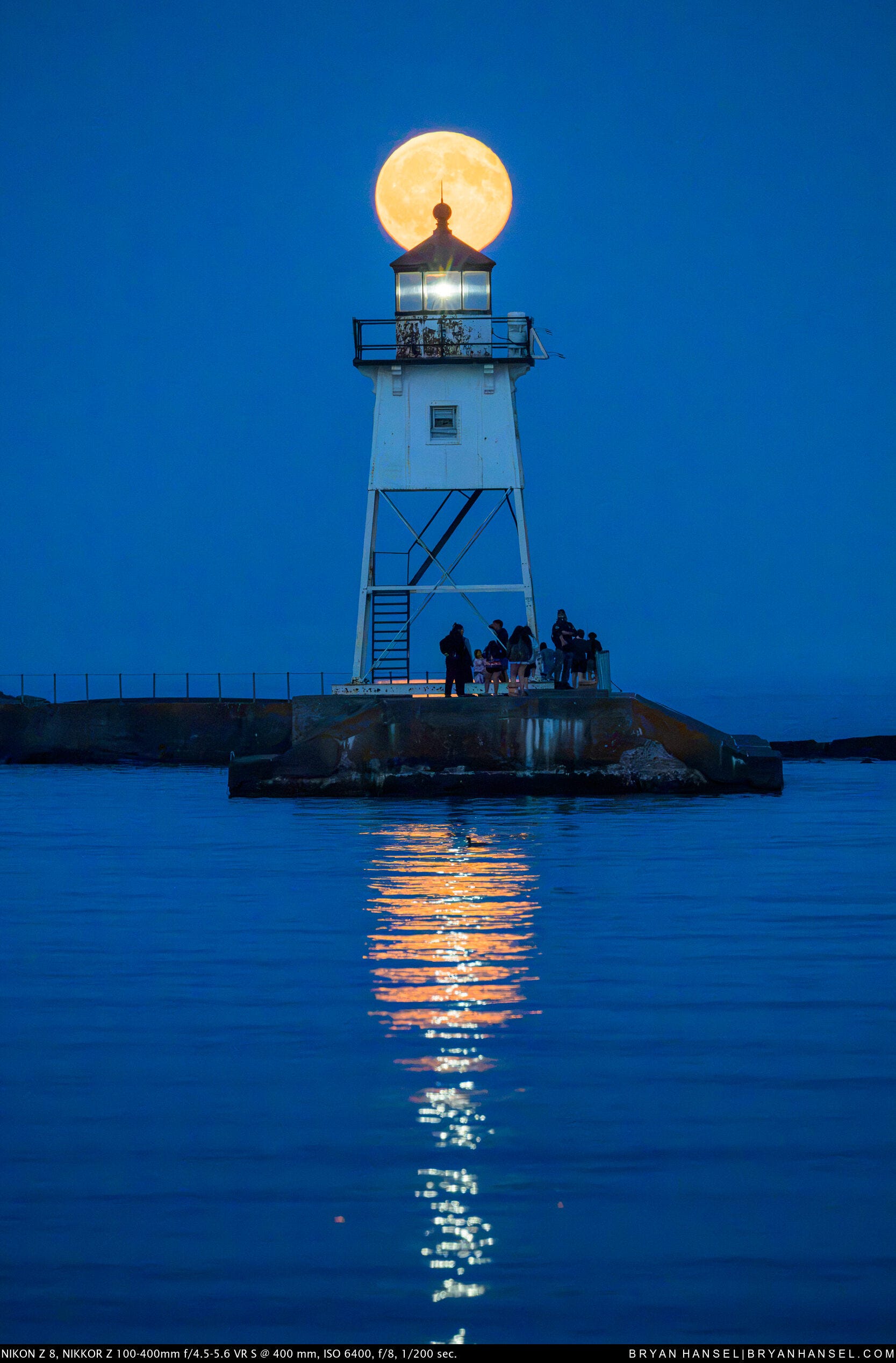
Recently, a private photo workshop I was teaching fell on the full moon. Instead of photographing the sunset, which is what I usually do for private lessons, we waited for the nearly full moon to rise behind the Grand Marais lighthouse. I had planned for the moon to rise inside the lighthouse’s legs, with nearly the same amount of space above and below it. This would be one of the best alignments of the year, but we’d only have a few minutes to capture it.
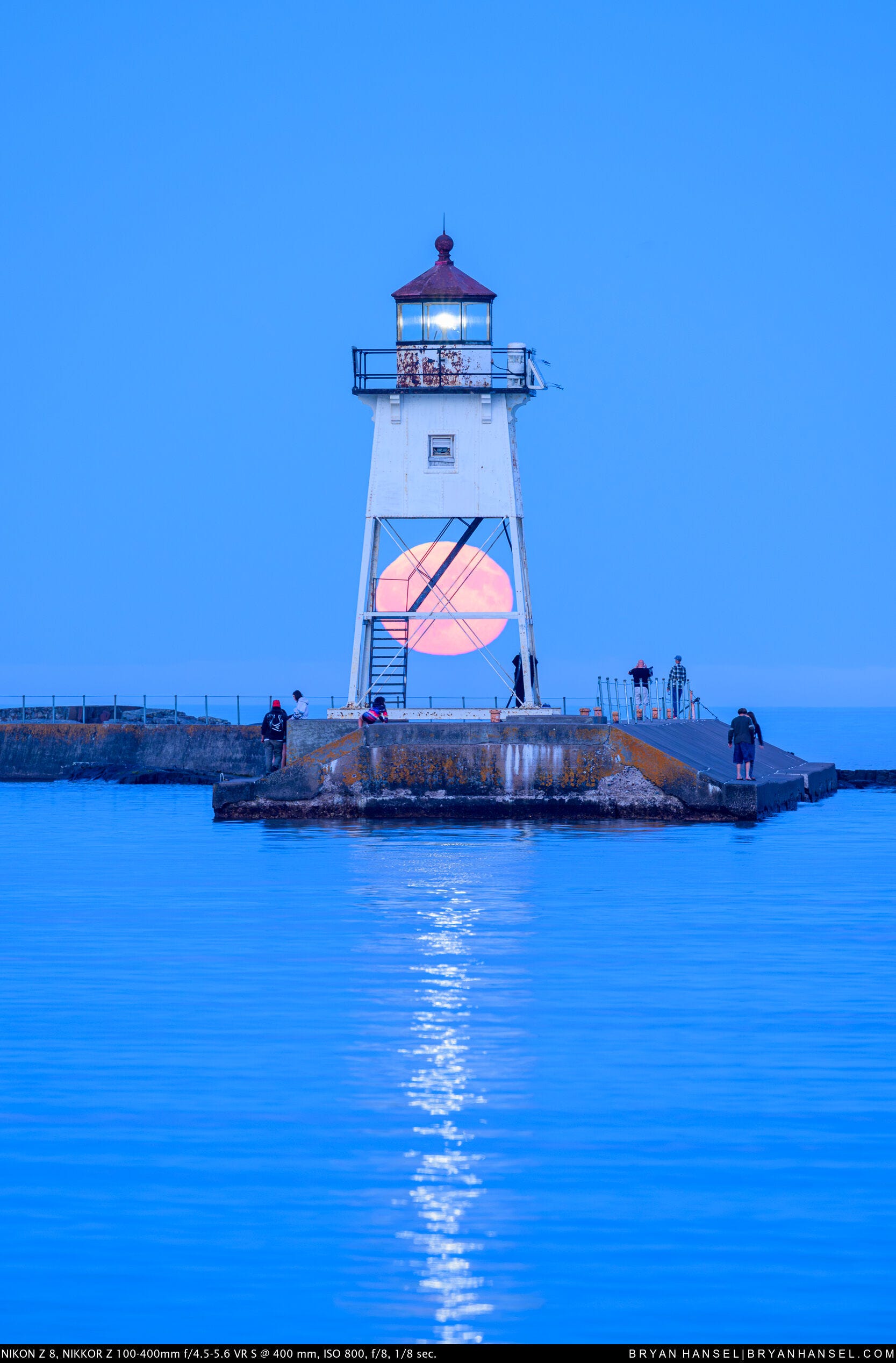
Usually, I shoot the moonrise on the day before the full moon. While the moon looks full, it rises early enough that the setting sun may still cast light on the subject. Depending on the subject, moonrises within about 10 minutes of sunset can also work.
This August offered three possibilities. The day before the full moon, the moon would be 4° above the horizon at sunset. On the evening of the full moon, it would be at 1.3°. The following night, it would rise just after sunset. Normally, that would be too late, but it offered something the other two nights didn’t: a nearly perfect alignment between the moon and the lighthouse legs.
Planning this photo required two measurements: the apparent size of the moon and the height of the opening beneath the lighthouse.
The moon appears approximately 0.5° wide in the sky. I measured the opening beneath the lighthouse at about 0.9°. That meant that, when centered, the moon would fit inside the legs with about 0.2° of space above and below.
I could have measured the opening using a handheld clinometer, or calculated it mathematically, but I used a simpler technique. By holding my arm straight out in front of me with my pinkie extended, my pinkie’s width covers approximately 1° of the sky. My three middle fingers cover around 5°. I used my pinkie with its bottom aligned to the horizon to estimate the height of the lighthouse opening.
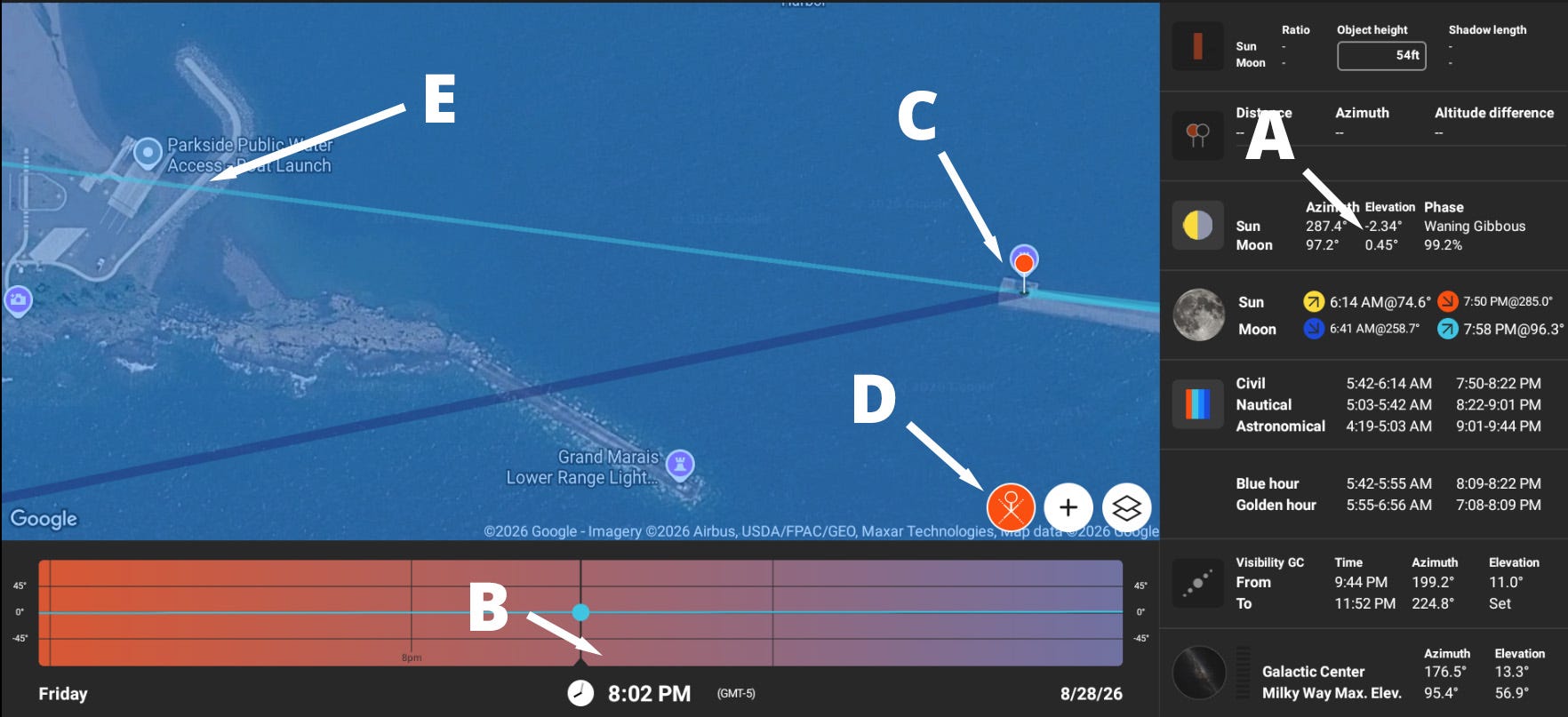
Once I knew the moon would fit, I used PhotoPills to determine when that would happen and where I needed to stand.
Because the opening was approximately 0.9° high, I wanted the moon’s center at 0.45°. The moon’s elevation in PhotoPills is referenced to the center of the moon. I moved the Time Bar (B) until the elevation shown in the Sun/Moon position panel (A) reached 0.45°. PhotoPills predicted that would happen at 8:02 pm.
I then placed the map pin on the lighthouse (C) and extended the moon’s azimuth line (D). Because the moon rises in the east, the line extending west from the lighthouse showed where I needed to photograph it from. I followed that line until it crossed the breakwater at point E.
At that point, all we had to do was show up, find the spot on the breakwater, set up our telephoto lenses, and wait.
Atmospheric refraction makes it difficult to predict the moon’s position perfectly. Near the horizon, Earth’s atmosphere bends the moon’s light and can make it appear higher than its actual position. PhotoPills accounts for standard atmospheric refraction, but actual conditions vary. Even so, the prediction was close enough. With slight adjustments along the breakwater, we put the moon where I wanted it.
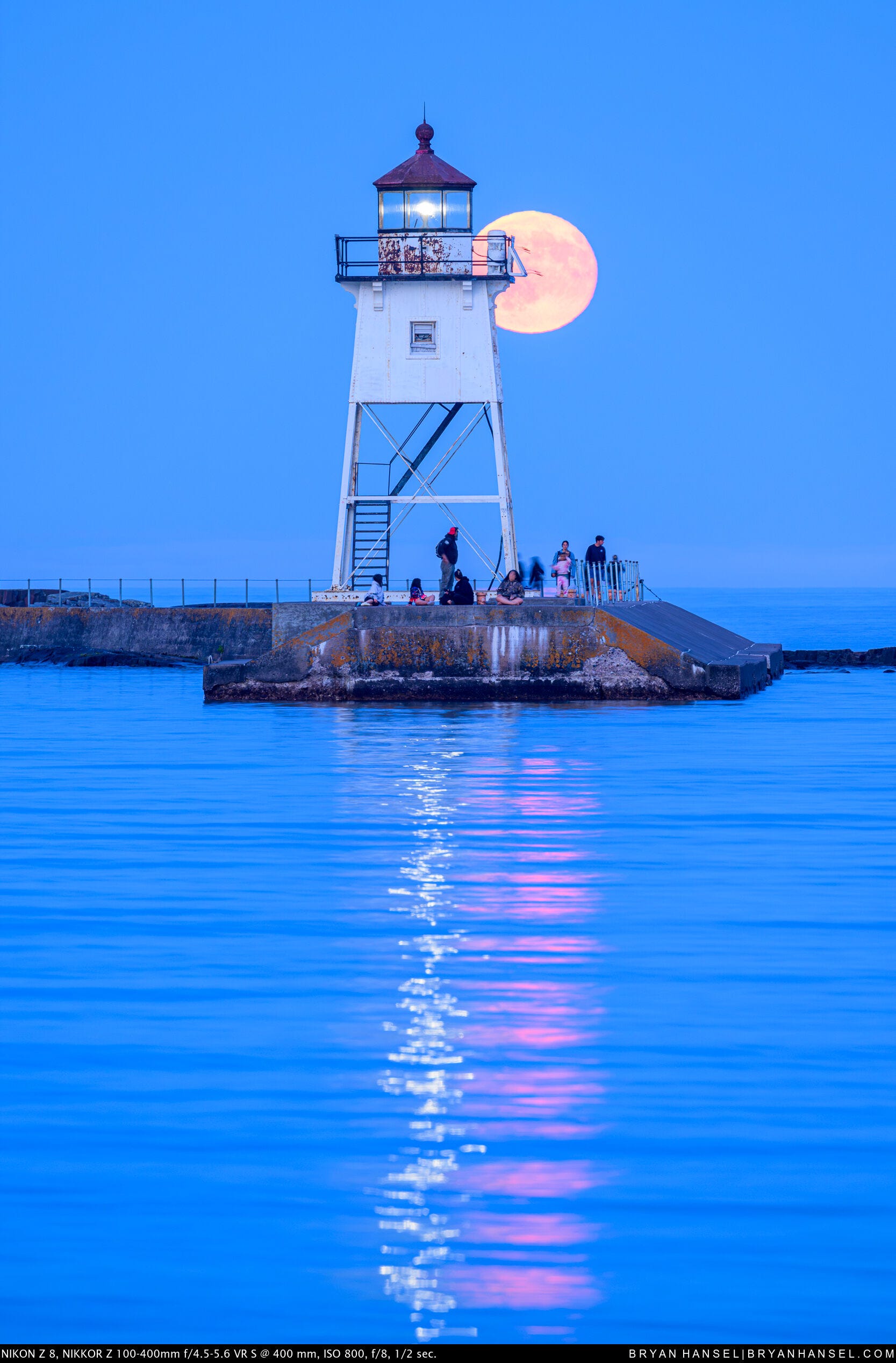
The planned photo lasted only for a short time. As the moon climbed higher into the sky, it passed behind the legs and alongside the lighthouse. Moving our tripods gave us new compositions to try. As luck would have it, the Hjørdis sailed into the harbor. So, I switched to a wider view to capture the moon, the lighthouse, and the schooner in one shot.
As the moon climbed further, the sky turned darker. The challenge was trying to shoot a bright moon with a dark harbor, lighthouse, and water. I needed to preserve detail in the moon while still capturing detail in the foreground. In this situation, the key is to avoid overexposing the moon.
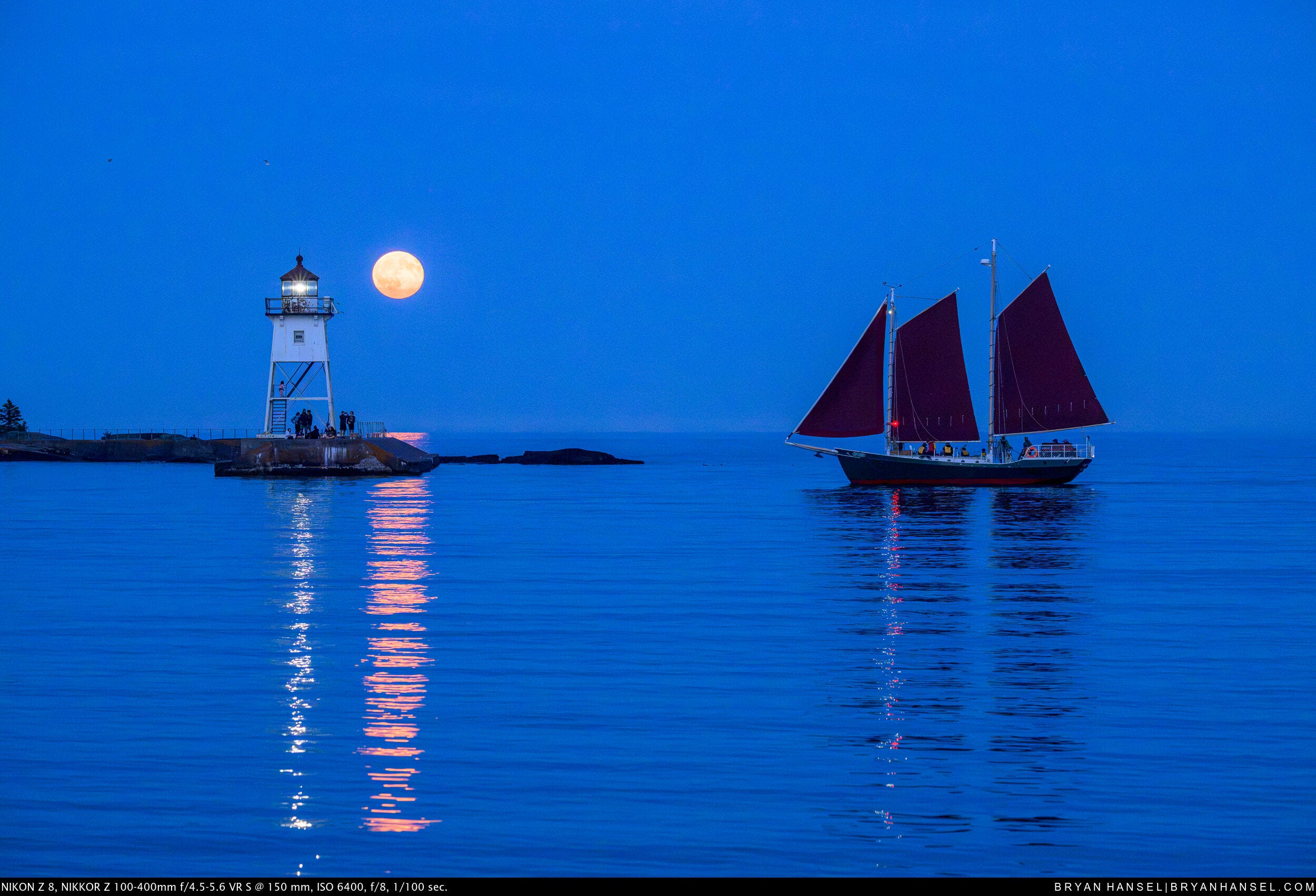
By the time the moon reached 3° at 8:20 pm, the foreground was around three stops darker than I had hoped. I still shot to preserve the highlights in the moon, and then during editing I brightened the exposure by three stops and preserved the highlights by reducing them, and then I ran an aggressive Denoise setting of +65.
When the evening started, I knew I wanted the planned shot, and all the calculations put us in the right place at the right time with the moon centered between the lighthouse legs. But the evening didn’t end there. When the moon climbed higher and the Hjørdis entered the harbor, we changed our compositions and responded to the scenes that were unfolding in front of our eyes. While planning gave us the photograph that I had envisioned, we took advantage of other opportunities.
Until next time
Fall has started on the North Shore. Some of the early-turning ridges have started to transition to reds, and it won’t be long until peak color arrives at the end of the month and beginning of next month.
I’ll be traveling by bike for part of September, so I haven’t decided what form my next newsletter will take. It may be shorter, but it probably won’t be another in the style of the Namekagon River report. I’m aiming to keep the same schedule, but forgive me if I don’t.
I always forget to mention my photography workshops during the summer. Then fall arrives, I look at the calendar, and I panic a little. I have a few spaces left on my Online Lightoom Class and a space on my April Spring in the Great Smoky Mountains Photo Workshop. The Smokies are one of my favorite national parks, and spring is my favorite time to photograph there, so I’m surprised the workshop still has room.
Until next time,
Bryan
These are so cool! And absolutely beautiful !!
I was wondering if you positioned someone under the lighthouse asking people not to stand between the lighthouse legs? Beautiful photo Brian!